 Shayuquan
evolution Shayuquan
evolution
-
- Shayuquan
stems from the substantiation of the original principles of Taijiquan,
and other "external", "internal" and "self-defence"
martial arts, in the light of the latest scientific knowledge,
such as physics, functional anatomy and bionics. Ömer
Humbaraci
and 30 of his students from Hamburg and Rome developed Shayuquan
between 1993 and 2004. A remarkable teacher and researcher, he
studied various western and oriental martial arts and sports
for more than 45 years. He was particularly interested in finding
means to reach efficiency (doing more with less) and freeing
"internal martial arts" from confusion, mysticism and
philosophical speculation. Together with the Sinologist
Juliane Koch, he worked at a practical translation from classical
Chinese of the famous "Taijiquan Jing" (Treatise on
the Long Fist). The results were gathered in a book (French,
unpublished) with the title "The Secret of the Chinese
Cash-string".
The teachings of this treatise had a great influence on the development
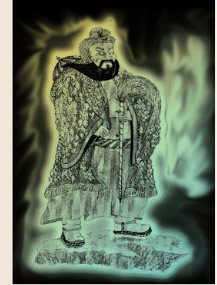
of Shayuquan. (Upper right corner: Zhang Sanfeng,
patron of Taijiquan and presumed author of the "Taijiquan
Jing", design by Juliane Koch)
-
- Fields
of knowledge that contributed to the development of Shayuquan:
- Newtonian
physics (mechanics & statics), geophysics, functional anatomy
(osteology and myology), sport science, general physiology, neurology,
bionics, zoology, (marine)
biology, hydrodynamics, biocinematics according to Dr. W. Packi,
lateral thinking according to Edward de Bono, semiotics, general
semantics according to Alfred Korzybski, behavioural psychology,
ethology, ethnology (shamanism),
communication and anti-communication, Sinology (Chinese language
and culture, in particular archaic characters, martial art classics
and military treatises) traditional Chinese medicine (especially
Qigong and Tuina), theology, history of art, iconography, etc.
- The methods
applied were:
- "trial
and error", "verification" and especially "falsification", videotaping
and slow motion study of practical applications, and the subjective
and objective evaluation of their effects in various contest
situations. The aim of this research was to reach physical efficiency
in body and mind techniques (more effect with less energy consumption)
- exactly what "internal martial arts" claim for themselves.
-
- Glossary
(simplified)
-
- Bionics: applied science that tries to solve technical
problems by studying natural models. One of the first to use
this method in the West was Leonardo da Vinci. He said: "Those
who orientated themselves at anything else but Nature, master
of all masters, belaboured in vain". On the other hand,
Taoists preached the "Wu Wei" principle, which can
also be understood as "Not acting against the nature of
things".
Ethology: science of the behaviour of animals and human
beings; research in behaviour.
-
- Verification: to confirm the correctness of something
by examination and comparison with ascertained values.
-
- Falsification: to contradict an assertion or a theory
by means of empiric observation or logical proof.
|
- back
to top
|